Choosing the right technology for your business website can be confusing. You may have heard that WordPress is affordable and easy to manage, while custom web development offers more flexibility and scalability. But which option is actually better?
The answer depends on what your business needs today and where you want it to go in the future.
A small business that needs a simple website may be perfectly happy with WordPress. A company that needs a custom dashboard, SaaS platform, customer portal, advanced integrations, or unique workflows may benefit more from custom web development.
In this guide, we compare custom web development vs WordPress across cost, flexibility, performance, SEO, security, scalability, maintenance, and long-term business needs.
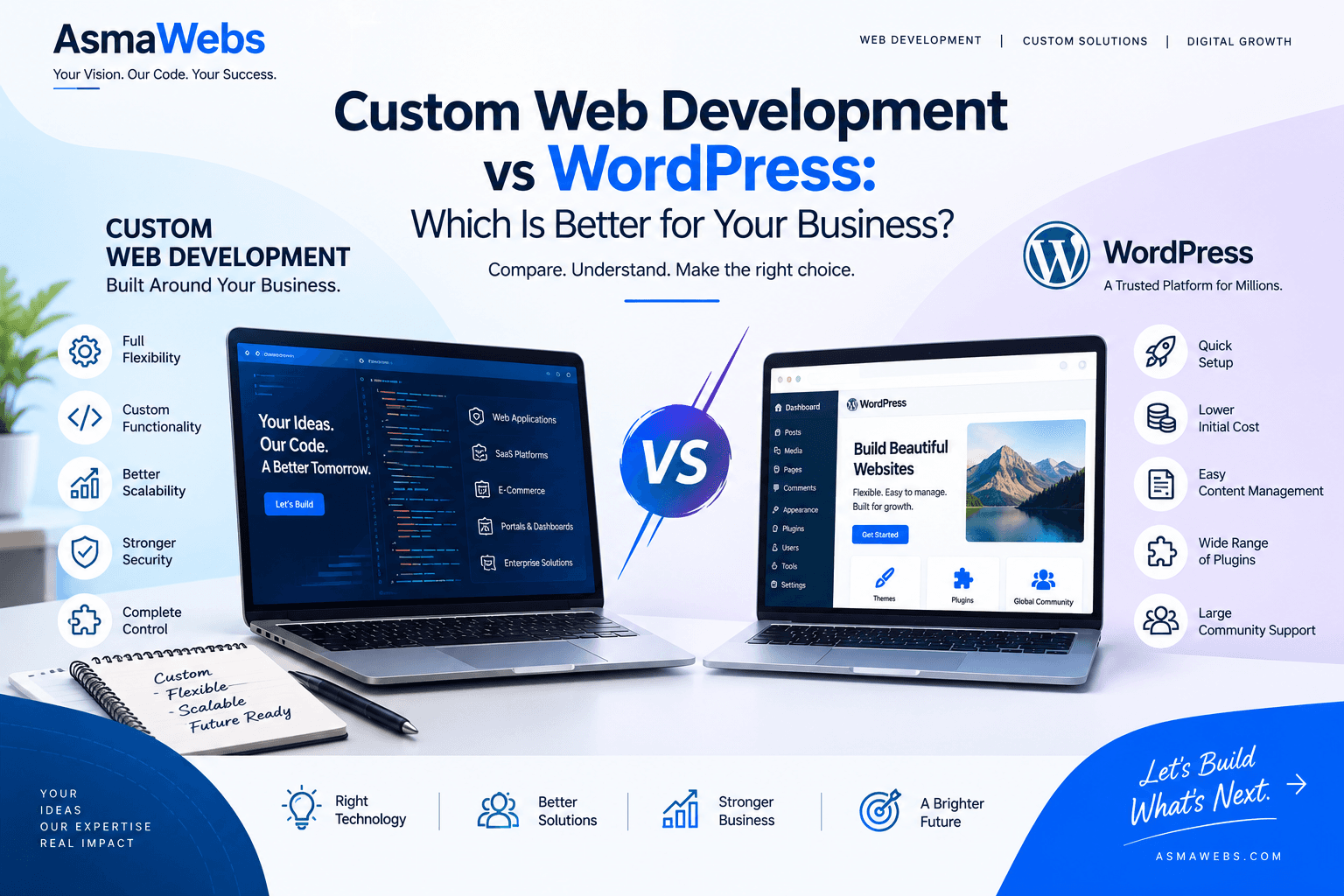
Custom Web Development vs WordPress: Quick Answer
WordPress is generally better for businesses that need a cost-effective website that can be launched and managed quickly. Custom web development is usually better for businesses that need unique functionality, greater control, advanced integrations, or long-term scalability.
There is no universal winner.
The right choice depends on your budget, business model, technical requirements, expected traffic, integrations, and future plans.
What Is Custom Web Development?
Custom web development means creating a website or web application specifically around a business's requirements rather than relying mainly on an existing theme or plugin structure.
A custom website can be built with technologies such as React, Angular, Vue.js, Node.js, Python, Java, .NET, or other suitable frameworks and platforms.
For example, a business may need:
A custom customer dashboard
An employee portal
A booking platform
A SaaS application
CRM or ERP integrations
Custom payment workflows
Advanced reporting
User-specific functionality
APIs and third-party integrations
In these situations, custom website development can provide much more flexibility.
The main advantage is that the technology can be designed around the business instead of forcing the business to work around a pre-built system.
What Is WordPress?
WordPress is a popular content management system that allows businesses to create and manage websites without developing everything from scratch.
Businesses can use themes, plugins, page builders, and custom development to create different types of websites.
WordPress can be a practical choice for:
Business websites
Blogs
Portfolio websites
News websites
Content-focused websites
Small e-commerce stores
Landing pages
Marketing websites
One of its biggest advantages is its large ecosystem. Businesses can find thousands of themes and plugins for different requirements.
However, WordPress may become less suitable when a project requires highly specialized functionality or a complex application architecture.
Custom Web Development vs WordPress: Key Differences
Factor | Custom Web Development | WordPress |
|---|
Flexibility | Very high | Moderate to high |
Initial cost | Usually higher | Usually lower |
Development time | Can take longer | Often faster |
Custom functionality | Excellent | Depends on plugins/customization |
Scalability | Highly customizable | Good for many websites |
Ease of content management | Depends on development | Excellent |
Plugin dependency | Low | Can be high |
Design control | Very high | High with customization |
Maintenance | Requires technical support | Easier for standard websites |
Best for | Complex and unique projects | Content and standard business websites |
1. Which Is More Affordable?
When comparing custom web development vs WordPress, cost is usually one of the first questions businesses ask.
WordPress generally has a lower starting cost because businesses can use existing themes, plugins, and established development workflows.
Custom development usually requires more planning, design, development, testing, and technical resources. Therefore, the initial investment can be higher.
But the cheapest option is not always the best option.
If your business requires functionality that WordPress cannot provide efficiently, repeatedly adding plugins or custom modifications can increase development and maintenance costs over time.
The better question is not simply:
2. Which Gives You More Flexibility?
This is where custom web development has a major advantage.
With a custom solution, developers can build functionality specifically around your business processes.
For example, imagine you operate a logistics company and need a platform that allows customers to book shipments, track deliveries, generate invoices, and communicate with drivers.
A standard WordPress website may not be the ideal foundation for such a system.
A custom web application can be designed specifically around those workflows.
WordPress can also be customized, but extensive customization may require more plugins or custom coding.
3. Which Is Better for Website Performance?
Website performance depends on many factors, including hosting, code quality, images, databases, third-party scripts, caching, and overall architecture.
A well-developed WordPress website can perform very well.
However, custom development allows developers to have greater control over the underlying architecture and functionality.
That can be useful when performance requirements are very specific or the application needs to handle complex processes.
The important point is that custom development does not automatically mean a faster website, and WordPress does not automatically mean a slow website. Good development practices matter in both cases.
4. Which Is Better for SEO?
Both WordPress and custom websites can be SEO-friendly.
WordPress makes many SEO tasks relatively easy through its ecosystem of plugins and content management features.
A custom website can also be built with strong technical SEO foundations, including:
Clean URLs
Proper heading structure
Fast loading pages
Mobile responsiveness
Structured data
XML sitemap
Canonical URLs
Optimized images
Crawlable architecture
Internal linking
Therefore, SEO-friendly website development is possible with either approach.
What matters most is how the website is developed and maintained.
5. Which Is More Secure?
Security depends heavily on implementation and maintenance.
WordPress itself is widely used, but websites can become vulnerable when outdated themes, plugins, weak passwords, or poor configurations are left unmanaged.
Custom applications can also have security vulnerabilities if they are poorly developed.
A professional website development company should consider security throughout the development process.
This includes secure authentication, access control, software updates, data protection, backups, HTTPS, and secure API practices where applicable.
So, don't assume that custom automatically means secure or that WordPress is insecure.
6. Which Is Easier to Manage?
WordPress has a clear advantage when it comes to content management.
Business owners and marketing teams can generally create and update pages, publish blogs, upload images, and manage content through the WordPress dashboard.
A custom website can also include a content management system, but the editing experience depends on how the system has been developed.
If your main requirement is publishing content regularly, WordPress can be a very practical option.
7. Which Is Better for Scalability?
If you expect your business to grow significantly, scalability should be considered before development begins.
A custom application can be architected around expected users, workflows, integrations, and future features.
For example, a startup may begin with a simple platform but later need:
Multiple user roles
Subscription payments
Advanced dashboards
API integrations
Mobile applications
Automation
Analytics
Third-party services
A properly planned custom web development solution can accommodate these requirements more directly.
That does not mean WordPress cannot scale. Many large websites use WordPress successfully. The question is whether its architecture remains appropriate for your specific requirements.
When Should You Choose WordPress?
WordPress can be a good choice if you:
Need a website quickly
Have a limited initial budget
Need a content-heavy website
Want easy content management
Need a standard business website
Run a blog or publication
Don't require highly specialized functionality
For these businesses, paying for a completely custom application may add unnecessary complexity.
When Should You Choose Custom Web Development?
Custom web development may be a better choice if your business needs:
Unique functionality
Complex workflows
SaaS products
Customer or employee portals
Advanced dashboards
Complex API integrations
Custom business automation
Enterprise applications
Highly specialized e-commerce functionality
Long-term scalability
If your website is actually becoming a core part of your business operations, custom development deserves serious consideration.
How to Decide Between Custom Development and WordPress
Ask yourself these five questions:
1. What type of website do I need?
A simple business website and a complex SaaS platform have very different requirements.
2. How much customization do I need?
If your website needs unique workflows or functionality, custom development may be more appropriate.
3. Who will manage the website?
If your marketing team needs to update content regularly without technical assistance, WordPress may be convenient.
4. What is my long-term plan?
Think beyond the initial launch. Consider what features your business may need in the next three to five years.
5. What is my realistic budget?
Don't choose a technology only because it is cheaper initially. Consider development, hosting, maintenance, updates, integrations, and future changes.
Can WordPress and Custom Development Work Together?
Yes.
It doesn't always have to be an either-or decision.
A business can use WordPress for its marketing website while using a separate custom application for complex business functionality.
For example:
WordPress website → Marketing + Content
Custom application → Customer portal + Business operations
This approach can give businesses the benefits of easy content management while keeping complex functionality separate.
The right architecture depends on the project.
How AsmaWebs Can Help
Choosing between WordPress and custom development should start with your business requirements, not with a technology trend.
At AsmaWebs, the focus is on understanding the project first and then selecting an appropriate development approach.
Our web development services can support businesses looking for responsive websites, custom web applications, e-commerce platforms, portals, and scalable digital solutions.
Whether your project needs WordPress development or custom web development, the goal should be the same: build a website that is useful for your customers and supports your business objectives.
Final Verdict: Custom Web Development or WordPress?
There is no single answer to custom web development vs WordPress.
Choose WordPress when you need a practical, content-friendly and cost-effective website with standard functionality.
Choose custom web development when your business needs specialized functionality, complex integrations, unique workflows, or a platform designed for long-term growth.
The best technology is not necessarily the newest or most expensive one. It is the technology that solves your business problem effectively.
Before making a decision, define your requirements, understand your budget, think about future growth, and speak with an experienced web development company that can explain both options honestly.
Build the technology around your business, not your business around the technology.