Many businesses invest significantly in digital marketing, driving qualified traffic to their landing pages only to watch potential leads vanish without converting. When revenue stalls, marketing campaigns are often blamed. However, the root issue frequently lies within the digital infrastructure itself.
Subtle technical oversights, outdated workflows, and poor user interface choices silently erode your conversion rates. A modern digital presence requires more than an attractive homepage—it demands high performance, fluid usability, and strategic code architecture.
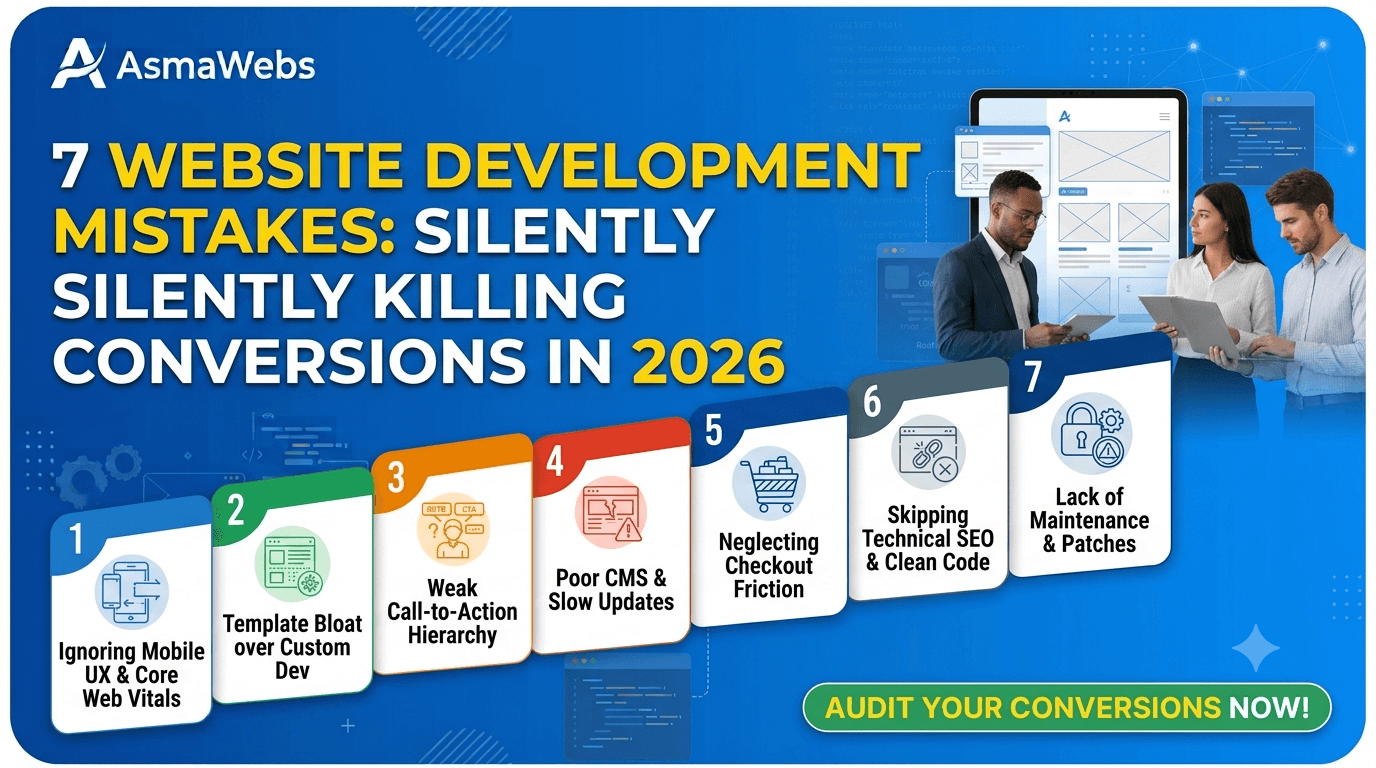
Avoid these seven critical website development mistakes that may be silently draining your business revenue in 2026, along with actionable solutions to fix them.
Why Standard Website Metrics Miss Revenue Leakage
Traditional web analytics often fail to reveal why visitors leave before making a purchase or submitting an inquiry. Standard metrics like high pageviews or low bounce rates can mask underlying technical issues.
[ Traditional Web Analytics ] ──> Focuses on: Pageviews, Sessions, & Clicks
                                      │
                                      ▼ (Hides Technical Friction)
                                      │
[ Real User Experience (RUM) ] ──> Uncovers: Input Lag, Layout Shifts, & Broken Flows
                                      │
                                      ▼
                      [ Recovered Business Revenue ]
A user might land on a product page, spend 45 seconds trying to tap a delayed checkout button, experience a visual jump, and abandon the session entirely. To analytics tools, that visit registers as "high engagement." In reality, it was a lost sale.
Modern website development services focus on measuring real user interactions rather than aggregate session data. Addressing technical friction at the code level helps prevent revenue loss before it affects your bottom line.
1. Ignoring Mobile UX and Core Web Vitals
Over 60% of web traffic originates from mobile devices, yet many websites are still built desktop-first. Sacrificing mobile responsiveness directly impacts revenue and search visibility.
Google's Core Web Vitals measure key performance metrics:
Largest Contentful Paint (LCP): Measures loading speed (target: ≤2.5s).
Interaction to Next Paint (INP): Measures visual responsiveness (target: ≤200ms).
Cumulative Layout Shift (CLS): Measures visual stability (target: <0.1).
  Poor Core Web Vitals (LCP > 2.5s, INP > 200ms)
                     │
                     ▼
  Frustrated Users + Lower Google Search Rankings
                     │
                     ▼
    Increased Cart & Lead Form Abandonment
When elements jump around while loading or buttons lag upon tapping, users quickly leave. Partnering with a skilled website development company in India ensures your site is fully optimized for Core Web Vitals across mid-tier mobile networks and varied screen sizes.
2. Choosing Template Bloat Over Custom Web Development
Off-the-shelf templates and budget website builders often come loaded with unnecessary features. They rely on pre-packaged stylesheets, bloated script bundles, and dozens of third-party plugins just to display simple page elements.
Feature Metric | Generic Template Builders | Custom Web Development |
|---|
Code Efficiency | Heavy, redundant code bundles | Lightweight, bespoke codebase |
Page Speed & Performance | Slower due to unused scripts | Optimized critical rendering path |
Security Risk Profile | Higher; target for plugin vulnerabilities | High; custom security layers |
Scalability & Adaptability | Restricted by theme limits | Fully scalable to custom requirements |
Investing in custom web development ensures your site includes only the exact code, features, and assets required. Eliminating template bloat results in faster load times, cleaner navigation, and higher visitor conversion rates.
3. Weak Call-to-Action Hierarchy
A visually appealing website will fail to generate leads if visitors cannot easily determine their next step. Weak visual hierarchy and competing calls-to-action (CTAs) create decision fatigue, causing users to drop off.
Common CTA mistakes include:
Competing Priorities: Placing "Book a Demo," "Download Whitepaper," and "Contact Us" buttons next to each other with equal visual weight.
Low Contrast Design: Using subtle background colors for primary action buttons that blend into the surrounding design.
Vague Button Copy: Using generic labels like "Submit" or "Click Here" instead of action-oriented phrases such as "Get Your Free Audit."
Professional business website development arranges content logically, guiding visitors toward a single, clear action on every page.
4. Poor CMS Development & Slow Content Updating
Marketing teams require the agility to publish landing pages, launch campaigns, and update product information without waiting weeks for developer assistance.
Relying on poorly built content management systems or rigid, hard-coded templates creates operational bottlenecks. When updating a product price or publishing a blog post breaks the layout, marketing efforts slow down, missing valuable market opportunities.
Scalable CMS development empowers non-technical team members to manage content effortlessly while maintaining site design and brand consistency.
5. Neglecting E-Commerce Checkout Friction
For online stores, the checkout process is the most critical conversion step. Complicated, multi-step checkouts frustrate buyers and lead to high rate of abandoned carts.
  [ Complex Multi-Step Checkout ]      Vs.      [ Optimized Streamlined Flow ]
  - Forced Account Creation                    - Guest Checkout Enabled
  - Hidden Fees at Final Step                  - Transparent Pricing Upfront
  - Limited Payment Gateways                   - One-Click Digital Wallets
              │                                             │
              ▼                                             ▼
  ❌ High Cart Abandonment                     ✅ Higher Conversion Rates
Modern ecommerce website development focuses on reducing purchase friction. Implementing guest checkout options, auto-filling address fields, displaying clear order summaries, and supporting one-click wallet payments directly recovers lost sales revenue.
6. Skipping Technical SEO and Clean Code Standards
A visually striking website is ineffective if prospective customers cannot find it on search engines. Surface-level SEO tactics—like meta tags and keyword placement—are insufficient if underlying code issues prevent search engines from properly indexing your pages.
Critical technical SEO flaws include:
Unstructured Schema Markup: Preventing search engines from understanding your business details, products, or services.
Bloated DOM Structure: Slowing down rendering engines and delaying indexing.
Broken Internal Linking: Creating dead ends for web crawlers and diminishing domain authority distribution.
Clean code standards and structured web application development ensure search engine crawlers can index your pages efficiently, boosting organic visibility and driving targeted traffic.
7. Lack of Post-Launch Maintenance and Security Patches
Launching a website is not a one-time project; digital platforms require ongoing upkeep. Neglecting post-launch maintenance introduces performance degradation, broken integrations, and security vulnerabilities over time.
Unmaintained websites often face:
Database & Plugin Conflicts: Outdated extensions causing unexpected layout shifts or site crashes.
Security Vulnerabilities: Outdated software exposing user data and damaging brand credibility.
SSL & API Breakages: Expired security certificates or outdated payment gateways silently breaking lead forms and checkouts.
Establishing a consistent maintenance plan ensures your site remains secure, fast, and fully functional as web standards evolve.
How to Audit Your Business Website for Conversion Blocks
If your website traffic is holding steady but conversions are declining, perform a structured audit to identify and fix performance bottlenecks:
Run Field Data Audits: Use Google PageSpeed Insights to review real-user Core Web Vitals (LCP, INP, CLS) rather than relying solely on desktop lab tests.
Test Real Mobile Devices: Navigate your primary conversion flows on mid-tier mobile devices using standard 4G connections.
Streamline Conversion Pathways: Review every lead form and checkout funnel, removing non-essential input fields.
Inspect Code Quality: Check for unused JavaScript bundles, uncompressed media files, and failing third-party scripts.
Fixing these technical conversion barriers turns passive visitors into active clients. Contact AsmaWebs today to audit your platform and build a high-performing digital solution designed for long-term growth.
FAQ
1. How does web development directly impact business conversion rates?
Web development directly impacts conversion rates by optimizing loading speeds, visual hierarchy, mobile responsiveness, and transactional user flows. A slow, poorly structured, or non-responsive website creates user friction, leading to high abandonments before visitors can complete a form or purchase. Clean code architecture reduces technical bounce triggers and maintains user engagement across all devices.
2. What are Core Web Vitals, and why are they critical for sales conversions?
Core Web Vitals are Google’s standardized metrics measuring real-world user experience: site loading speed (LCP), user responsiveness (INP), and visual stability (CLS). They are critical for conversions because slow load times or jumpy page elements frustrate users, causing immediate drop-offs. Meeting recommended Core Web Vitals thresholds keeps visitors on-site and improves organic search rankings.
3. Why does custom web development convert better than generic website templates?
Custom web development converts better than pre-built templates because it eliminates bloated code, unused scripts, and redundant plugin dependencies that slow down page speeds. A custom codebase is built specifically around your unique user journey, providing faster rendering times, seamless checkout integrations, and superior technical security.
4. How does technical SEO differ from basic on-page SEO in web development?
Technical SEO focuses on underlying code structure, site speed, crawlability, and structured schema markup, whereas on-page SEO deals primarily with visible text and keywords. Without clean DOM structures, proper indexing rules, and fast server responses, search engines cannot efficiently rank a site—regardless of how well the written content is optimized.
5. What causes high e-commerce cart abandonment during the checkout process?
High cart abandonment is primarily caused by complex multi-step forms, forced account registration, slow page transitions, unexpected fees, and limited payment gateway options. Streamlining the flow with guest checkouts, one-click digital wallets, and responsive UI elements reduces purchase friction and significantly improves completion rates.