Benefits and Limitations of AI Automation in Modern Businesses
Businesses of every size are asking the same question: should we automate with AI? From startups using chatbots to enterprises running predictive analytics, AI automation for business has moved from experiment to everyday tool.
But it isn’t a magic fix. Understanding both the benefits and limitations of AI automation helps you adopt it wisely instead of blindly. This guide gives you a balanced view.
What Is AI Automation?
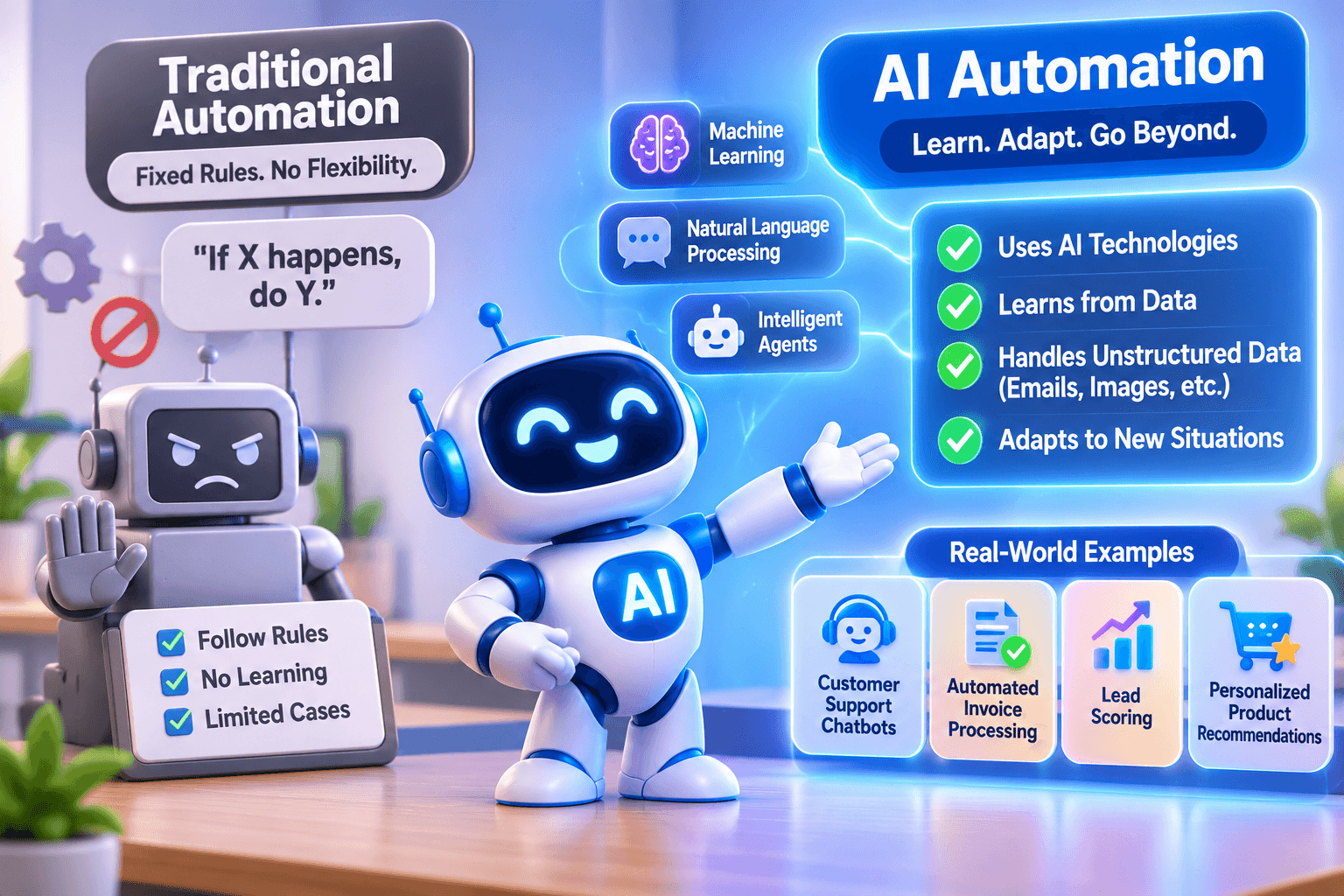
AI automation uses artificial intelligence, such as machine learning, natural language processing, and intelligent agents, to perform tasks with little or no human input.
Traditional automation follows fixed rules: “if X happens, do Y.” AI automation goes further. It can learn from data, handle unstructured information like emails or images, and adapt to new situations. Common examples include customer support chatbots, automated invoice processing, lead scoring, and personalized product recommendations.
Key Benefits of AI Automation for Businesses
Here are the main advantages of AI automation.
1. Increased Efficiency and Productivity
AI systems work around the clock without breaks. Tasks that take a person hours, like sorting data, tagging support tickets, or scheduling posts, can be finished in minutes. This speed lets teams get more done without extending working hours.
2. Reduced Operational Costs
By automating repetitive work, businesses cut the time and money spent on manual processes. Fewer errors also mean less rework. The upfront investment can be significant, but many companies see long-term savings as automation scales.
3. Improved Accuracy and Consistency
Humans get tired and distracted, and that leads to mistakes. Well-trained AI applies the same logic every time, which is valuable for data entry, compliance checks, and quality control.
4. Better Data-Driven Decisions
AI can analyze large datasets in real time and surface patterns people would miss. Predictive analytics helps businesses forecast demand, spot churn risks, and optimize pricing, so decisions rest on evidence rather than guesswork.
5. Enhanced Customer Experience
Customers expect fast answers. AI-powered chat and email tools respond instantly, and recommendation engines personalize the experience. The result is faster resolutions and more relevant interactions.
6. Easy Scalability
When demand grows, automated systems handle higher volume without a matching increase in headcount. That makes it easier to grow during peak seasons or expand into new markets.
7. More Time for High-Value Work
When AI handles the repetitive tasks, employees can focus on strategy, creativity, and relationship-building. This often improves job satisfaction too.
Real-World Examples of AI Automation Benefits
Customer support: Chatbots handle common questions and route complex tickets to the right agent.
Marketing: AI tools help with email personalization, ad optimization, and content ideation.
Finance: Automated invoicing and fraud detection reduce manual review.
HR: Resume screening and onboarding workflows speed up hiring.
E-commerce: Inventory forecasting and product recommendations improve sales and reduce stockouts.
Limitations and Challenges of AI Automation
Now the other side. These are the disadvantages of AI automation and the AI automation challenges businesses should plan for.
1. High Initial Investment
Software licenses, integration work, and team training all cost money. For small businesses, the upfront cost can feel steep, and the return may take months to show.
2. Data Quality and Availability Issues
AI is only as good as the data behind it. Incomplete, outdated, or messy data leads to poor results. Many businesses discover they need to clean and organize their data before automation can work properly.
3. Lack of Human Judgment and Creativity
AI struggles with nuance, emotion, and context. A chatbot may answer a question correctly yet miss that the customer is frustrated. Creative strategy, ethical decisions, and sensitive conversations still need people.
4. Security and Privacy Risks
Automation often involves sensitive customer or company data. Without proper safeguards, this creates exposure to breaches and compliance problems, especially under regulations like GDPR. Choosing secure, compliant tools is essential.
5. Integration with Legacy Systems
Older software doesn’t always connect smoothly with modern AI tools. Integration can be time-consuming and may require custom development or system upgrades.
6. Bias and Errors
AI learns from data, and if that data contains bias, the output can too. Some AI tools also produce confident but incorrect answers, often called hallucinations. Without oversight, these errors can spread at scale.
7. Workforce Concerns and Skill Gaps
Employees may worry about job displacement, which can hurt morale and adoption. There is also a skills gap: teams need training to work effectively alongside AI tools.
8. Over-Reliance on Automation
If a business depends too heavily on automated systems, a failure or outage can disrupt operations. Without human backup, problems may go unnoticed until they become serious.
Benefits vs Limitations: Quick Comparison
Aspect | Benefit | Limitation |
|---|
Cost | Long-term savings | High upfront investment |
Speed | Faster processing | Needs setup and monitoring |
Accuracy | Fewer manual errors | Can repeat errors at scale |
Decisions | Data-driven insights | Lacks human judgment |
Scalability | Handles growth easily | Depends on data and infrastructure |
How to Overcome the Limitations of AI Automation
The challenges are real, but manageable with the right approach.
Start small. Pick one high-impact, low-risk process, such as support ticket sorting, and expand once it works.
Keep humans in the loop. Let AI handle the routine and have people review sensitive or high-stakes outputs.
Invest in clean data. Audit and organize your data before you automate.
Choose secure, compliant tools. Check data handling policies and certifications.
Train your team. Upskill employees so they see AI as a helper, not a threat.
Monitor and refine. Track performance regularly and adjust workflows as needed.
Is AI Automation Right for Your Business?
Before you invest, ask yourself:
Do we have repetitive, time-consuming tasks?
Do we have enough quality data to support automation?
Are our goals clear, such as saving time, cutting costs, or improving experience?
Do we have the budget and team capacity to implement and maintain it?
If you answered yes to most, you’re likely ready to begin. If not, start with a smaller pilot or focus on improving your data and processes first.
The Future of AI Automation
AI agents that can plan and complete multi-step tasks are becoming more accessible, and no-code platforms are lowering the barrier for small businesses. As the technology matures, the winners won’t be the companies that automate the most, but the ones that automate the right things and keep human oversight where it matters.
Conclusion
The benefits and limitations of AI automation go hand in hand. On one side are speed, savings, accuracy, and scalability. On the other are upfront costs, data challenges, security risks, and the need for human judgment.
The key takeaway is that success depends on strategy, not just tools. Start with clear goals, test on a small scale, protect your data, and keep your people involved. Done right, AI automation becomes a powerful growth driver instead of an expensive experiment.
Ready to explore AI automation for your business? Start by identifying one repetitive process you could automate this month.
FAQs
What are the main benefits of AI automation in business?
Higher efficiency, lower costs, better accuracy, data-driven decisions, improved customer experience, and easier scalability.
What are the disadvantages of AI automation?
High setup costs, reliance on quality data, security and privacy risks, integration difficulties, potential bias, and limited human judgment.
Can AI automation replace human employees?
It can take over repetitive tasks, but roles needing creativity, empathy, and complex judgment still depend on people. Many jobs will evolve rather than disappear.
Is AI automation expensive for small businesses?
It can be, but affordable no-code tools make it easier to start small and scale gradually.
Which industries benefit most from AI automation?
Customer service, e-commerce, finance, healthcare, marketing, and HR see strong gains.